The 5 Fire Extinguisher Mistakes I Find Most Often in Middle Tennessee Buildings
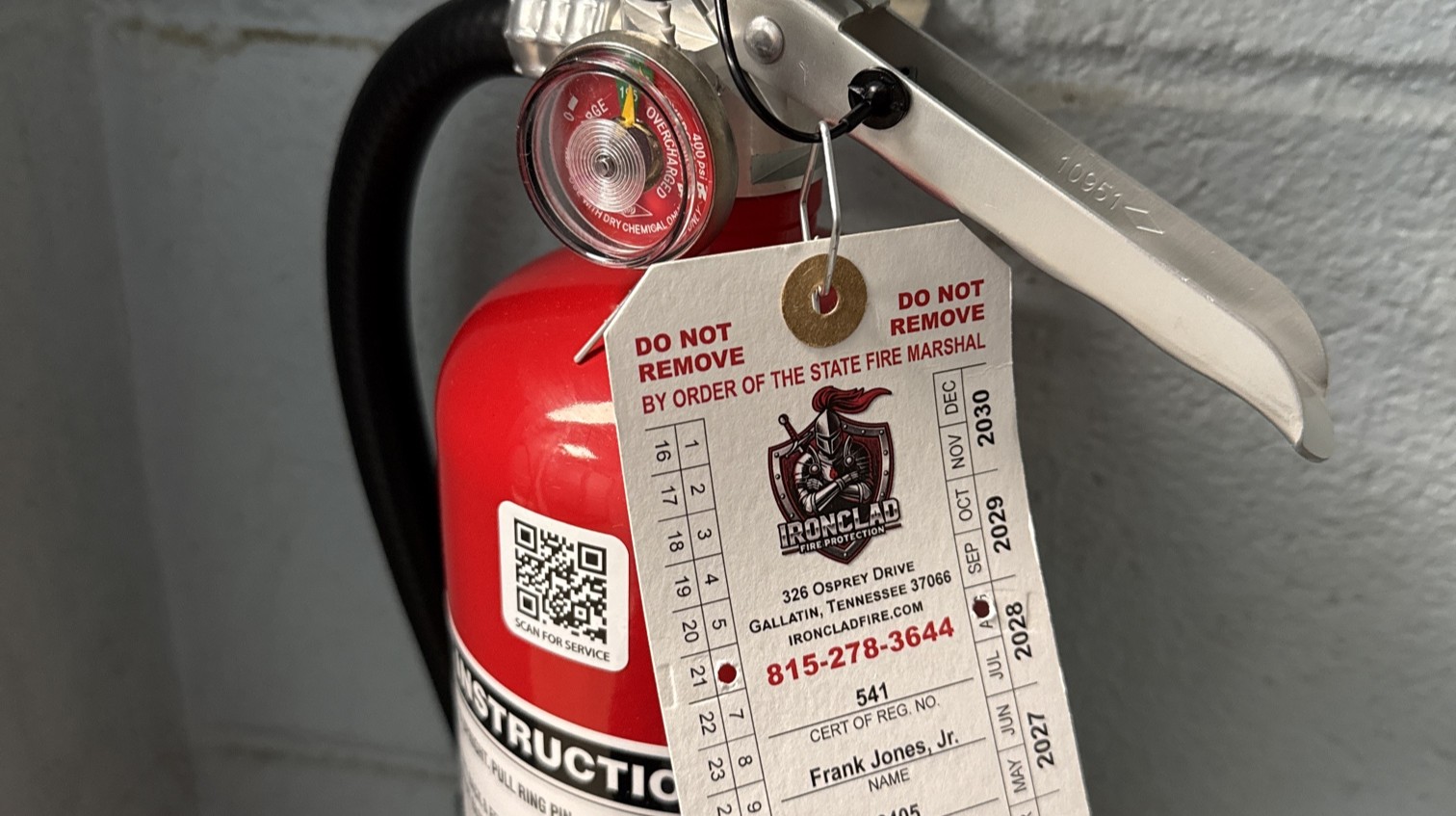
Five problems account for nearly everything I find wrong with fire extinguishers in commercial buildings. An expired tag and a unit that is not mounted are the first two.
The other three are damage nobody recognized as damage, a unit hidden or missing entirely, and a gauge that is not in the green.
Notice what is not on that list. The extinguisher being the wrong type almost never turns out to be the problem.
Ironclad’s Field Experience
An expired tag is the number one thing a fire marshal will write up. It takes them three seconds to check and it is the first thing they look at.
Mounting is the number one thing that is actually wrong. Those are two different lists, and most buildings I walk into have a current tag on a unit sitting on the floor.
That gap is worth understanding, because passing an inspection and being genuinely covered are not the same accomplishment. Below is what I look for, in the order I run into it.
If you want the equipment question answered separately, our fire extinguisher types guide covers which units belong in which areas.
1. The Inspection Tag Has Expired
This is the most cited violation in commercial buildings, and it is the easiest one to prevent.
NFPA 10 requires an annual maintenance check on every extinguisher at 7.3.1, and Tennessee enforces it through the fire code. The hanging tag is the visible proof.
OSHA 1910.157(e)(3) adds a separate workplace duty to record the maintenance date and keep that record.
A tag goes stale for ordinary reasons. A management change, a vendor change, a tenant turnover, or simply nobody being assigned to watch the date.
The tell is the date on the tag, not the presence of one. A tag hanging on the unit means nothing if it reads fourteen months ago.
Two things fix this permanently. Assign one named person per building to own the service date, and use a provider that reminds you before it lapses rather than after.
Ironclad sends automatic annual reminders for exactly this reason. An overdue inspection is a preventable finding, and a customer should not be the one keeping track of it.
For what the intervals actually are, see our inspection frequency guide. For handling a citation you already received, see our fire marshal violations guide.
2. The Extinguisher Is Not Mounted
This is the one I find most often, and it is almost never deliberate. Somebody took the unit down, or the bracket broke, or it arrived new and never got hung.
Ironclad’s Field Experience
The single most common thing I find is an extinguisher sitting on the floor with no hook.
After that it is units set on a shelf, a counter, or a table, hung on a nail, or strapped up with whatever was handy.
An unmounted extinguisher gets kicked, moved, buried behind something, or knocked over. In an emergency it is not where anyone expects it, and that is the whole point of a fixed location.
NFPA 10 sets the limits. The bottom of the unit belongs at least 4 inches off the floor, and the top no higher than 60 inches. Units over 40 pounds mount lower, though those are uncommon in most commercial spaces.
Hip level is the practical target. It is easy to see, easy to lift down in a hurry, and it keeps the cylinder off the floor where it will get moved.
If you find a unit on the floor, the fix is a bracket, not a better spot on the floor. Every extinguisher should have a dedicated mount that it returns to.
3. Damage Nobody Recognized as Damage
People generally know a fire extinguisher can go bad. What they do not know is what bad looks like.
Ironclad’s Field Experience
A lot of the time people have no idea that a dent or corrosion is a problem. A hose completely blocked with bug waste goes unnoticed constantly.
None of that looks broken from across the room. The unit is red, it is on the wall, and everyone assumes it works.
A dent can compromise a cylinder that holds pressure for a living. Corrosion does the same thing more slowly, and it shows up most in damp areas, loading docks, and mechanical rooms.
A plugged nozzle or hose is the quietest failure of the three. The extinguisher will still read full and still fail when someone squeezes the handle.
Take a unit out of service and call your provider if you see any of this:
- A dent, gouge, or deformation anywhere on the cylinder
- Rust or corrosion, particularly around the base
- A hose or nozzle that is cracked, dry rotted, or obstructed
- A damaged or missing handle, lever, or carrying grip
Do not try to repair any of it in house. In Tennessee, extinguisher service belongs to a registered firm, which our Tennessee requirements guide explains.
4. The Unit Is Hidden, or There Is Not One There
Two versions of the same failure. Either the extinguisher exists and nobody can see it, or the area never got one.
NFPA 10 requires extinguishers to be conspicuously located, clearly identified, and readily accessible. An extinguisher behind a plant is not accessible in any way that matters.
Ironclad’s Field Experience
Some people think fire extinguishers are ugly, so they try to hide them. In smaller places I find them shoved off in a corner behind a plant.
Missing units come up too. I was at a warehouse recently where the electrical room had no extinguisher at all.
I also redid the layout at an auto garage. It was up to code, technically. It just was not positioned to actually have an extinguisher when they needed one.
There is no clean rule you can apply from the hallway, but there is a reliable instinct. Walk your building and notice when you cannot see an extinguisher or a sign anywhere.
In a warehouse or a shop you should not have to look far to find one. In common areas, one should be in sight or clearly marked from wherever you are standing.
When that test fails, you either have a gap or a layout that needs rethinking.
NFPA 10 sets a maximum travel distance of 75 feet for Class A hazards, measured along the path a person actually walks. Class B is shorter, either 30 or 50 feet depending on the unit’s rating.
Our breakdown of the 75-foot rule covers how that plays out on a real floor plan, including the changes that quietly create gaps.
5. The Gauge Is Not in the Green
The pressure gauge is the one diagnostic anybody can read without training. The needle belongs in the green band. Anywhere else means the unit is not ready.
Ironclad’s Field Experience
When a gauge is low, we replace the unit. We never recharge it.
Low pressure is usually some form of slow leak. It can also be temperature, a broken tamper seal, or somebody accidentally pushing the lever down.
Recharging a leaking cylinder means paying for the recharge and then paying for the replacement anyway. If I wanted to make the most money, I would do recharges.
That position comes from watching it fail. At a shop where three technicians did recharges, 50 to 60 percent of recharged units leaked again, regardless of who did the work.
That points at the cylinder rather than the workmanship, and more nitrogen does not fix a cylinder.
Worth knowing: CO2 extinguishers have no gauge at all. They are checked by weight, so a cylinder that feels light has leaked or been partly discharged.
One thing I almost never find is a unit somebody actually used. Most extinguishers go their entire service life without the pin being pulled, which is exactly why the condition they sit in is the thing that matters.
Code Is the Floor, Not the Goal
Everything above can pass an inspection and still leave a building poorly covered. Meeting the legal minimum and being well protected are related, not identical.
Ironclad’s Field Experience
Placement is somewhat of an art and a science. If you look at building layouts, there is usually a specific way to position things.
If there is an exit door, you generally want an extinguisher by that exit door. It depends on the layout, obviously.
Just meeting the legal requirement does not always mean things are positioned optimally.
That is the difference between a technician checking boxes and someone thinking about how a person moves through your building while it is on fire.
What You Can Check Yourself
NFPA 10 requires a monthly visual inspection at 7.2.1, and the five problems above are exactly what it is meant to catch. It takes about five minutes in most buildings.
| What to check | What a problem looks like |
|---|---|
| The tag | A service date more than twelve months old |
| The mount | The unit on the floor, a shelf, a counter, or a nail |
| The body | Dents, rust, a cracked or plugged hose or nozzle |
| The location | Hidden behind furniture, or no unit in sight in an area |
| The gauge | The needle outside the green band |
Fix access and obstruction problems yourself, the same day. Anything involving the extinguisher itself goes to your provider.
For the full monthly walk and the service intervals behind it, see our guide to inspection frequency.
Want these corrected rather than just written down? That is our fire extinguisher service for commercial buildings.
Frequently Asked Questions
Which of these will a fire marshal actually cite?
Any of them, but the expired tag is the one they check first and find fastest. Blocked access and unmounted units are the next most likely, since both are visible from across a room.
Is an extinguisher sitting on the floor really a violation?
Yes. NFPA 10 requires units to be mounted in a bracket or cabinet, with the bottom at least 4 inches off the floor. On the floor is not a compliant location, no matter how visible it is.
Can I fix any of this myself?
You can move the boxes, hang a unit back on an existing bracket, and clear an obstruction. Recharging, repairing, replacing, and the annual inspection all require a registered Tennessee firm.
What should I do if the gauge is low?
Take the unit out of service and treat it as unavailable, then call your provider. A low gauge usually means a slow leak, and topping it off tends to buy a few months rather than a fix.
My last provider never mentioned any of this. Does that mean it was fine?
Not necessarily. A tag records that one unit was serviced on one date and passed. It says nothing about whether the building has enough units or whether they are in the right places.
The Bottom Line
Check the tag date, then look at everything the tag does not cover. Mounting, condition, visibility, coverage, and pressure are where buildings actually fall short.
A five minute walk each month catches all five. An annual visit from someone who is paying attention catches what the walk cannot.
Found something on your walk? Get a quote for fire extinguisher service in Middle Tennessee.