How to Prepare for a Tennessee Fire Marshal Inspection: What Actually Gets Checked
Most small businesses never do the monthly check, and the fire marshal is how they find out. That is the real reason an inspection feels like an event instead of a formality.
Buildings with a facilities team or a maintenance person usually stay on top of it. Everywhere else, nobody has looked at the equipment since the last time somebody was paid to.
The good news is that preparing is a smaller job than it sounds. Your monthly inspection is the preparation. Do it, fix what fails, and there is nothing special left for the week before.
What a Fire Marshal Actually Checks
The pass is narrower than most people picture. Knowing how narrow is what makes the rest of this manageable.
Ironclad’s Field Experience
I have been on site during an inspection by chance, never on purpose. Nobody hires me to walk alongside the fire marshal.
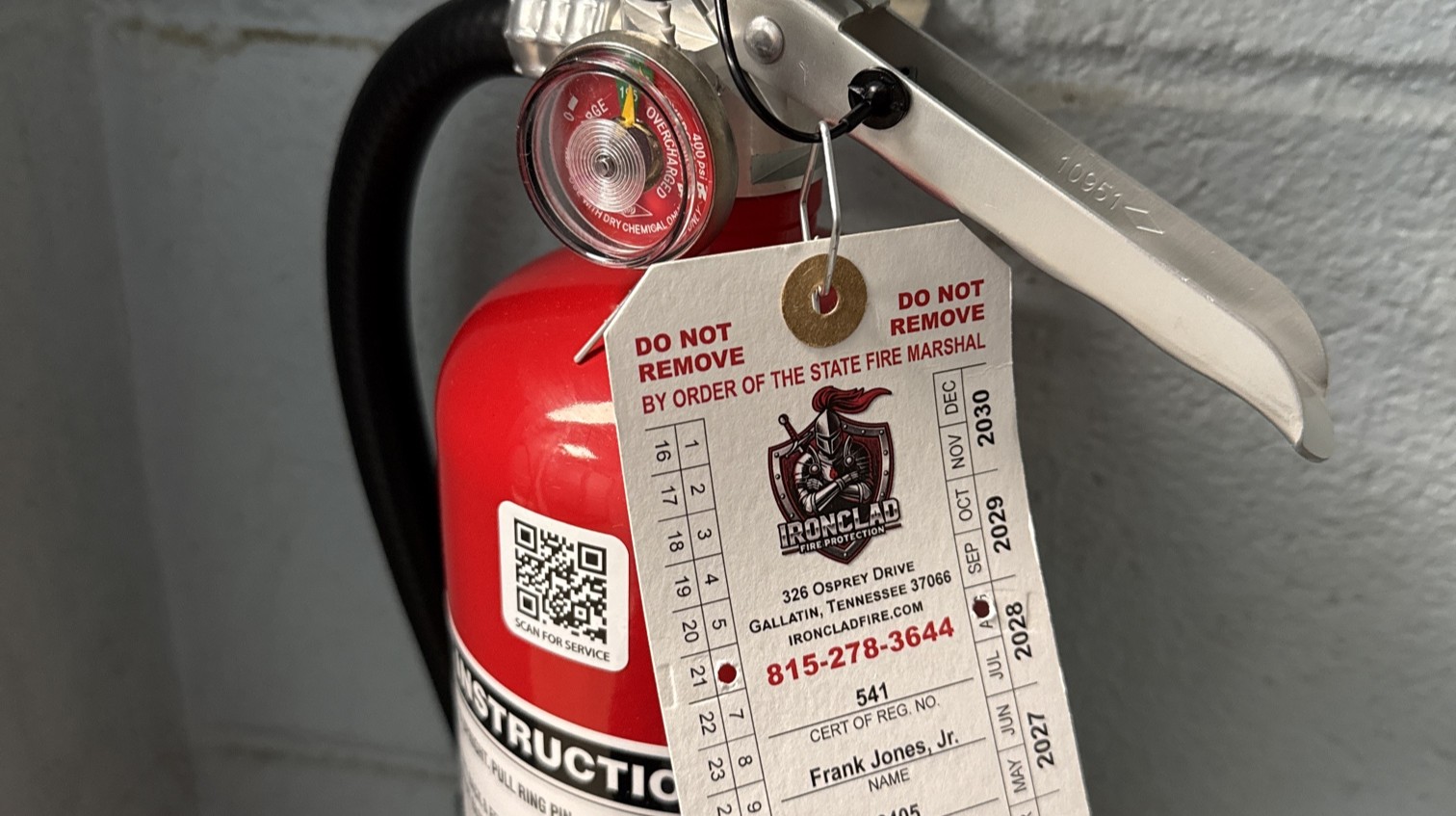
What they run is a slimmed-down version of what I run. For extinguishers they check the tag, whether it is on a hook, whether it is badly rusted, and whether the gauge is in the red.
Emergency lights are one button push. If it is dead, they note it.
For fire suppression systems, in my experience, they are checking tags.
That is a short list, and every item on it is something you can look at yourself this afternoon.
The scope of the visit still depends on your local authority. Tennessee’s State Fire Marshal’s Office lists the 2021 International Fire Code with state amendments among its adopted codes.
Approved jurisdictions also run their own inspections, so the specifics move from one city to the next.
Preparation Is Your Monthly Inspection
None of what follows is extra work invented for inspection season. It is the routine already required of you.
NFPA 10 sets the monthly visual check on extinguishers at 7.2.1, NFPA 101 sets the monthly emergency lighting test, and NFPA 17A sets a monthly quick check for suppression systems.
In a workplace, OSHA 1910.157 requires the extinguisher check as well.
You are not expected to inspect at a technician’s level. You are expected to notice when something is obviously wrong and get it corrected.
Fire Extinguishers
Once a month, confirm each unit is:
- In its assigned location with access clear
- Showing a gauge in the green
- Carrying an intact pin and tamper seal
- Free of dents, corrosion, and leaks, with a clear nozzle
- Turned so the instructions face out, and heavy enough to feel full when you lift it
Keep the record. NFPA 10 expects twelve consecutive monthly records, and a marshal asking for proof is asking for that, not a sticker.
Our guide to inspection frequency covers the full monthly walk, plus the longer intervals a tag does not show.
Emergency Lights and Exit Signs
Push the button on every unit, hold it for 30 seconds, and confirm it stays lit. That is the monthly test in NFPA 101, and battery-backed exit signs get the same treatment.
Writing it down is the part people skip. Pushing the button is easy, and a test nobody recorded is a test that did not happen.
The 90 minute annual test is a separate job with a different method. Our emergency light testing guide walks both, including what a failed unit usually means.
Kitchen Hood Suppression
The monthly quick check in NFPA 17A is genuinely quick. Confirm that:
- The system is in its proper location
- The manual pull station is unobstructed
- Tamper indicators and seals are intact
- Nozzle caps are in place and undamaged
- The gauge reads in range, if the system has one
Anything past that belongs to a licensed suppression contractor, and we are one.
NFPA 96 puts that professional inspection at every six months, not annually, which catches out operators who budgeted for one visit a year.
Service Any Tag Expiring Near the Inspection
This is the one scheduling decision worth making in advance, and it is the cheapest insurance on the page.
Ironclad’s Field Experience
If a tag is going to expire anywhere near the inspection date, I service it beforehand.
I am not saying a marshal will schedule a re-inspection over it. I am saying it costs nothing to remove the question.
The real risk is forgetting. People put it off, and the next thing you know they are two years behind.
A tag that is current when you schedule and expired when the inspector arrives is a finding you paid nothing to avoid and everything to fix.
Exits and the Hazards You Cannot Tag
Not everything a marshal writes up has a tag on it. This is the part no equipment provider is going to catch for you.
OSHA requires workplace exit routes to stay unobstructed and adequately lit, with exit signs visible where the direction is not obvious. The exit route standard is the workplace requirement.
Walk every exit path from the farthest point of the building and confirm nothing blocks it. Stairwells used as storage and doors locked during business hours are the two that fail fastest.
Inspectors also look at daisy-chained extension cords, temporary wiring used permanently, and how flammable or hazardous materials are stored.
Those are electrician and code-official questions. The requirements depend on your occupancy and what you keep on site.
What Almost Nobody Has Ready
The gap is rarely the equipment. It is that nobody has looked, and nobody kept the paper.
Ironclad’s Field Experience
Here is what turns up that the owner had no idea about.
Emergency lights that have been dead for years. Nobody has pushed a button, so nothing looks wrong.
Records that do not exist. The work was done and the report never arrived.
Storage that crept in. A cart or a stack of boxes that nobody registered as blocking anything.
Extinguishers that look fine from across the room. Up close they are dented, corroded, or the hose is packed solid with bug waste.
Keep one file with your service reports, test records, and any previous correction notices. Organize it by system and keep current reports separate from old ones.
A report that names locations is worth more than a stack of invoices. “Serviced three units” does not show which three.
Your Building Type Is Not the Question
Most preparation advice sorts readers by industry. That is not how any of this is written.
Ironclad’s Field Experience
People assume their building type has its own rulebook. The code is not written that way.
There is no section saying a school gets one thing and a warehouse gets another. The standards are the same either way.
What changes is the hazard. Different hazards mean different equipment, and that depends on what is actually in the room.
So the useful question is not what a restaurant or a school needs. It is what you have on site that can burn, and what puts it out.
A fryer is a Class K hazard whether it sits in a hotel, a hospital, or a diner. The kitchen is the reason, not the industry.
Our guide to extinguisher types maps hazards to the right unit, which is the version of this question worth your time.
On Inspection Day
Meet the inspector on time and give them access to what they ask for.
Hand over the specific record requested rather than the whole file. Take notes on each location and condition as you go.
Ask for the code section on anything you do not understand. You are not arguing, you are making sure you can close the finding on the first try.
If you do get written up, our guide to fire marshal violations covers correction deadlines and what closes each finding.
Frequently Asked Questions
How far in advance should I start preparing?
If your monthly checks are current, you are already prepared. If they are not, start with the walk and the records now, because a failed unit may need a part or a return visit.
Can my own staff do the monthly inspection?
Yes. The monthly visual check is explicitly an owner or staff task. Annual extinguisher service in Tennessee has to come from a licensed firm.
Does the marshal test every emergency light?
Not usually. They push the button on a few, which is enough to find a dead unit, and they will not walk a building with fifty of them.
How often does a kitchen hood system need professional inspection?
Every six months under NFPA 96, which is more often than most other fire protection equipment on the property.
What if I find something during my own walk?
Fix what you safely can, like clearing access or remounting a unit, and send the rest to a provider. Finding it yourself is always cheaper than a marshal finding it.
The Bottom Line
Do the monthly check on your extinguishers, emergency lights, and suppression system, and write it down. That is preparation, and it is most of the job.
Service any tag that expires near the inspection date, walk your exit paths, and keep one organized file of reports.
The inspection is not the problem. It is the reminder that nobody has looked at the equipment in a while, and the monthly check is what removes the reminder.
Need something corrected before an inspection? Get a quote for extinguisher, emergency light, or suppression service now.